

News | Transportation Students Attend WTS-LA Tour of Gerald Desmond Bridge Replacement Project
Stop the VideoNews
METRANS UTC
Transportation Students Attend WTS-LA Tour of Gerald Desmond Bridge Replacement Project
Friday, August 5, 2016
by By Griffin Kantz, B. S. Policy, Planning, and Development 2017
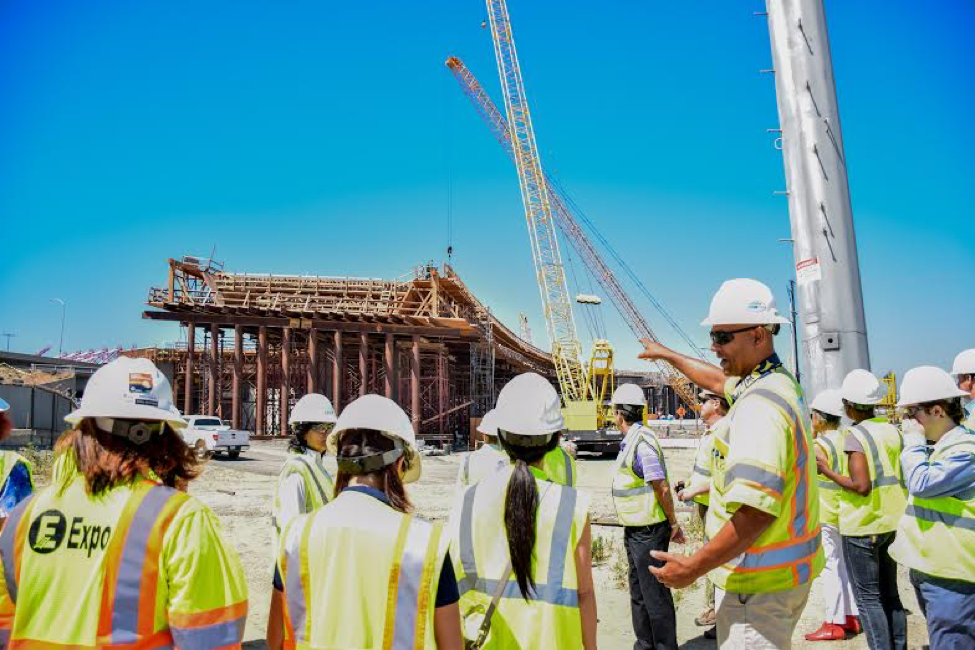
Photo by Feiyang Zhang, USC MPL 2016
Four USC student members of WTS in transportation-related fields were able to attend a recent site tour of the Long Beach Gerald Desmond Bridge Replacement Project, a professional event organized by the WTS Los Angeles area chapter.
The students—Wai Shong Chan, Griffin Kantz, Biying Zhao, and Feiyang Zhang—joined 20 professional WTS-LA members on July 22, 2016, for an engineering and planning briefing at the project’s Long Beach offices, followed by a 60-minute guided tour of significant design points along the new bridge alignment.
The Gerald Desmond Bridge Replacement Project is a $1.5 billion joint capital construction enterprise between Metro, the Port of Long Beach, and Caltrans to extend I-710 southwest from its current southern terminus near downtown Long Beach onto Terminal Island via a new bridge of the same name. The new cable-stayed span will replace the aging steel-arch Gerald Desmond Bridge which the Port built in 1965, as well as increase vertical clearance for inbound container ships from 155 feet to 205 feet.
Once completed, the new Gerald Desmond Bridge will feature the highest roadway deck of any American cable-stayed bridge and also be the nation’s second-tallest in the same category. The substantial increase in vertical clearance for container ships will be critical in the Port of Long Beach’s long-term efforts to handle ever-growing megaship sizes.
Building a bridge of such pronounced height on land essentially at sea level, while surrounded by constantly operating port facilities, vital freight corridors, and hundreds of crude oil wells, has posed unique engineering and design challenges for the design-build contractors. The tour guides discussed these constraints and the state-of-the-art methods the Port and the construction contractors are using to meet them. One of these innovations is a mobile scaffolding system, seen in the image below. Two of these steel frame manifolds form moveable, highly accessible scaffolding for new span segments, greatly reducing the amount of ground-level activity needed for construction. Students were fascinated to learn that the Gerald Desmond Bridge Replacement mobile scaffolding system is the first of its kind used in California.
The experience helped the four students diversify their professional network, since most had few to no connections to people or firms in the construction management sector, and even fewer involved in design-build. For some, it was also the first time visiting either of the L.A. Basin’s two ports.
WTS-LA, the coordinator for this tour, is the Los Angeles area chapter of WTS International, an organization dedicated to the professional advancement of women in transportation and the championship of their career accomplishments. For more information on the chapter and future events open to transportation students, see http://www.wtsinternational.org/losangeles/.
To learn more about the bridge replacement project, see http://www.newgdbridge.com/.
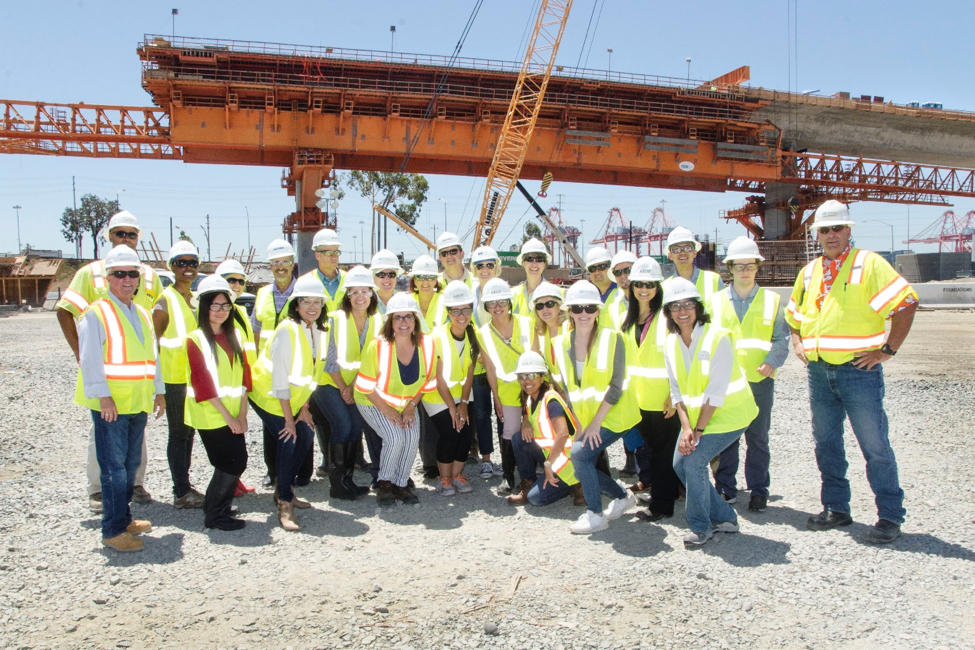
Photo by Melanie Nelson, Berg & Associates
Griffin Kantz
Kantz is a third-year undergraduate studying sustainable planning in the USC Sol Price School of Public Policy. He can be reached at [email protected].
News Archive
- December (1)
- November (6)
- October (4)
- September (1)
- August (3)
- July (4)
- June (3)
- May (7)
- April (8)
- March (10)
- February (8)
- January (7)
- December (7)
- November (8)
- October (11)
- September (11)
- August (4)
- July (10)
- June (9)
- May (2)
- April (12)
- March (8)
- February (7)
- January (11)
- December (11)
- November (5)
- October (16)
- September (7)
- August (5)
- July (13)
- June (5)
- May (5)
- April (7)
- March (5)
- February (3)
- January (4)
- December (4)
- November (5)
- October (5)
- September (4)
- August (4)
- July (6)
- June (8)
- May (4)
- April (6)
- March (6)
- February (7)
- January (7)
- December (8)
- November (8)
- October (8)
- September (15)
- August (5)
- July (6)
- June (7)
- May (5)
- April (8)
- March (7)
- February (10)
- January (12)
2026
2025
2024
2023
2022
2021
2020
2019
2018
2017
2016
2015
2014
2013
2012
2011
2010

Major Funders
Metrans Associate Partners