

News | METRANS Considers Measure M: Yes or No on Sales Tax Measure for LA Transit?
Stop the VideoNews
METRANS UTC
METRANS Considers Measure M: Yes or No on Sales Tax Measure for LA Transit?
Friday, November 4, 2016
by By Armeen Neshat, MPL 2018
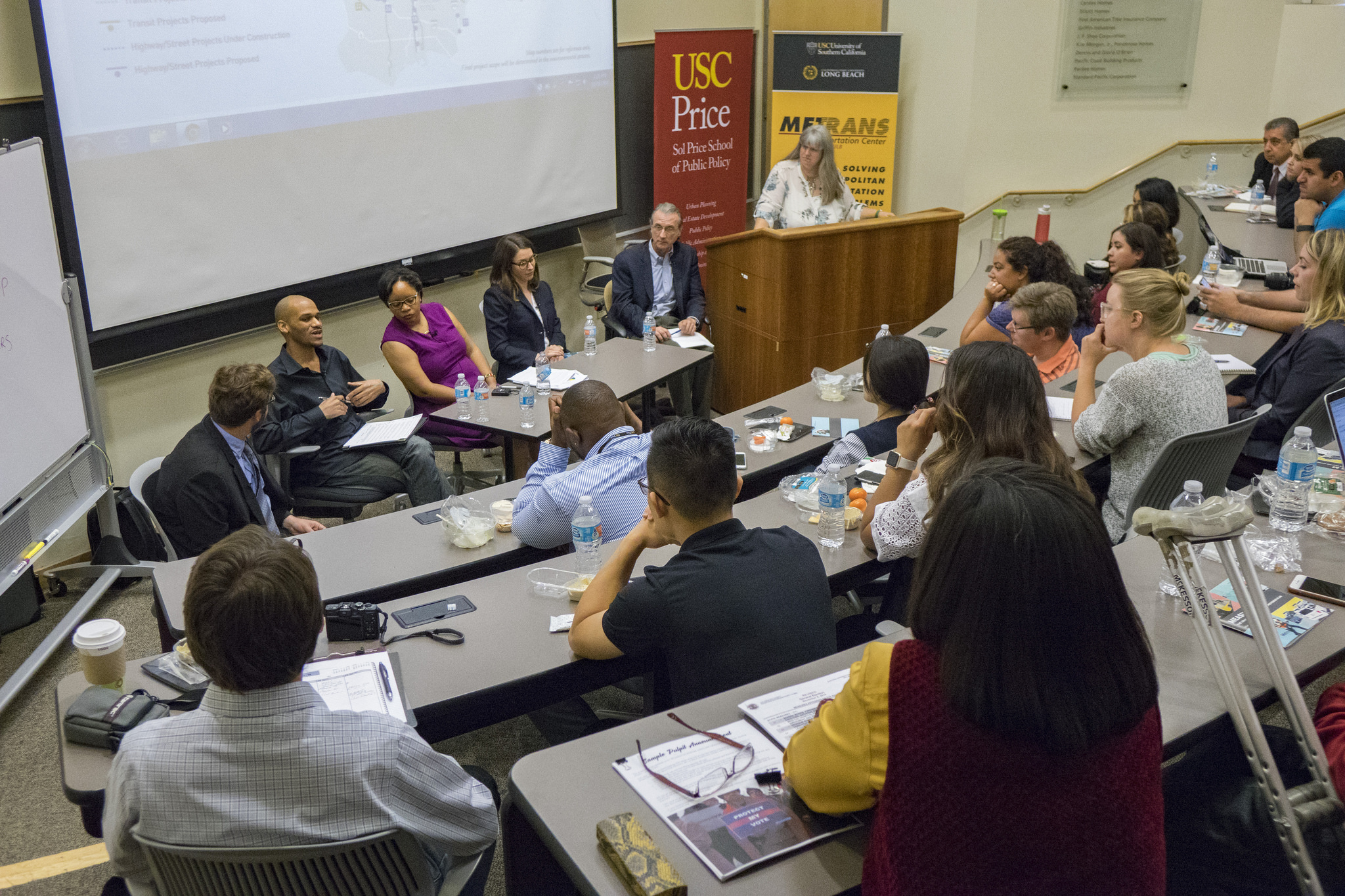
Photo by USC Sol Price School of Public Policy
On November 8th, Los Angeles voters will go to the polls to decide on a variety of issues and elected offices. One issue on the ballot is Measure M, a proposed sales tax increase to fund transportation projects in the county. The proposed measure would raise the county sales tax by an additional half cent and extend 2008’s Measure R until voters decide to end it. The measure is projected to raise $120 billion over the next 40 years, with funds allocated to specific transit projects, local return, and highway construction and expansion throughout the county. The measure must obtain a 2/3 majority for passage; similar Measure R passed in 2008 with 67% of the vote, and Measure J failing in 2012 with 66.61%. Projects funded by the Measure include a proposed subway tunnel under the 405 Freeway to LAX, an extension of the Purple Line to Westwood, and a new light rail line to Artesia, among others.
On Tuesday, October 18, METRANS co-sponsored a panel with the Price Urban Growth Seminar at the USC Sol Price Public Policy School on Measure M moderated by Dr. Lisa Schweitzer, with leading voices and experts on the issue weighing in. The panel consisted of Damien Goodmon, Executive Director of the Crenshaw Subway Coalition and leading organizer of the No on Measure M campaign; Laura J. Nelson, Transportation Writer for the LA Times; Dr. Mark Phillips, Assistant Professor of Economics and Tax Policy at USC; Dr. Jeffrey Sellers, Associate Professor of Political Science and Public Policy at USC; and Stephanie Wiggins, Deputy Chief Executive Office of LA Metro.
The panel discussed the feasibility of the measure passing, and its overall merits. Sellers noted that Measure M’s passage will depend largely on voter turnout, as histsorically transit initiatives suffer during low turnout in non-Presidential election years and flourish during Presidential election cycles. Goodmon argued that the measure does not go far enough to address equity concerns, with projects in the San Fernando and San Gabriel Valleys being given equal or greater priorities than areas with higher need in the South Bay and South Central Los Angeles County. Wiggins countered that the measure was constructed in a bottom-up process in order to benefit the entire county. Wiggins could not legally campaign in favor of Measure M as an employee of Metro. However, Member of the Metro Board of Directors, Jackie Dupont-Walker was in attendance of the panel and argued its merits. She noted that Measure M will redefine transit for the entire region by luring choice riders to the system, rather than remaining only for those with no alternative mode of transportation.
The panel led a vigorous discussion on Measure M, with participants largely agreeing on the importance of voting in this year’s election. Voters will decide on the fate of the measure next week, and this panel helped to educate on its complicated arguments.
A video recording of the panel can be found here.
Armeen Neshat
Armeen Neshat is a first year MPL student in the Sol Price School of Public Policy at the University of Southern California, with a concentration in Transportation and plans to pursue a certificate in Real Estate Development. He has a strong interest in transportation, economic inequality, and environmental issues.
News Archive
- December (1)
- November (6)
- October (4)
- September (1)
- August (3)
- July (4)
- June (3)
- May (7)
- April (8)
- March (10)
- February (8)
- January (7)
- December (7)
- November (8)
- October (11)
- September (11)
- August (4)
- July (10)
- June (9)
- May (2)
- April (12)
- March (8)
- February (7)
- January (11)
- December (11)
- November (5)
- October (16)
- September (7)
- August (5)
- July (13)
- June (5)
- May (5)
- April (7)
- March (5)
- February (3)
- January (4)
- December (4)
- November (5)
- October (5)
- September (4)
- August (4)
- July (6)
- June (8)
- May (4)
- April (6)
- March (6)
- February (7)
- January (7)
- December (8)
- November (8)
- October (8)
- September (15)
- August (5)
- July (6)
- June (7)
- May (5)
- April (8)
- March (7)
- February (10)
- January (12)
2026
2025
2024
2023
2022
2021
2020
2019
2018
2017
2016
2015
2014
2013
2012
2011
2010

Major Funders
Metrans Associate Partners