

Events
Stop the VideoEvents
METRANS UTC
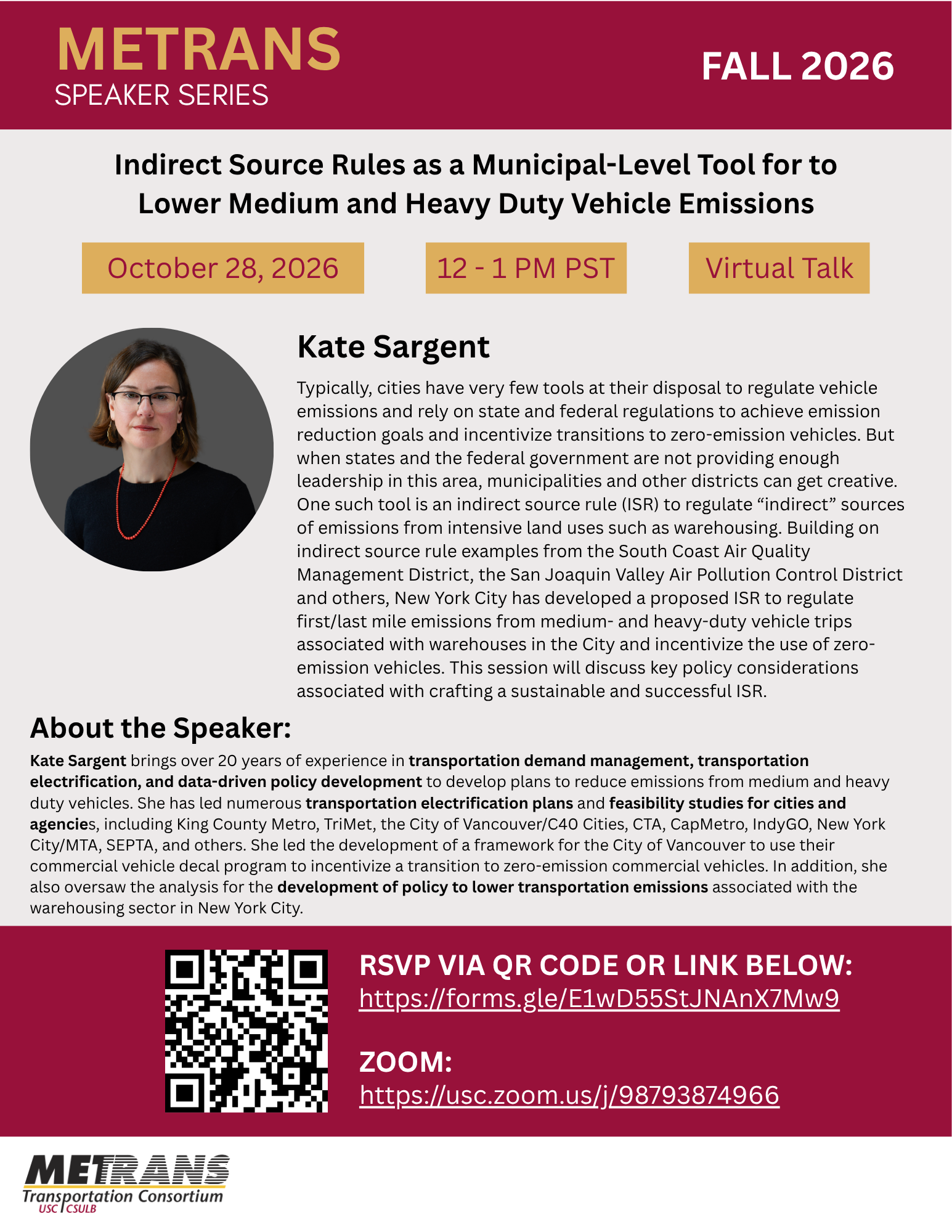
Indirect Source Rules as a Municipal-Level Tool for to Lower Medium and Heavy Duty Vehicle Emissions
Wednesday, October 28, 2026
METRANS UTC
Indirect Source Rules as a Municipal-Level Tool for to Lower Medium and Heavy Duty Vehicle Emissions
RSVP Here: https://forms.gle/E1wD55StJNAnX7Mw9
Zoom: https://usc.zoom.us/j/98793874966
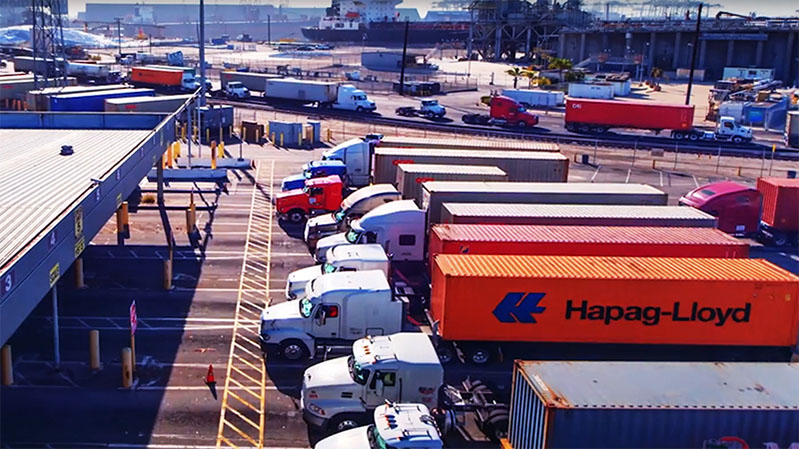
Typically, cities have very few tools at their disposal to regulate vehicle emissions and rely on state and federal regulations to achieve emission reduction goals and incentivize transitions to zero-emission vehicles. But when states and the federal government are not providing enough leadership in this area, municipalities and other districts can get creative. One such tool is an indirect source rule (ISR) to regulate “indirect” sources of emissions from intensive land uses such as warehousing. Building on indirect source rule examples from the South Coast Air Quality Management District, the San Joaquin Valley Air Pollution Control District and others, New York City has developed a proposed ISR to regulate first/last mile emissions from medium- and heavy-duty vehicle trips associated with warehouses in the City and incentivize the use of zero-emission vehicles. This session will discuss key policy considerations associated with crafting a sustainable and successful ISR.
Speaker Bio:
Kate Sargent brings over 20 years of experience in transportation demand management, transportation electrification, and data-driven policy development to develop plans to reduce emissions from medium and heavy duty vehicles. She has led numerous transportation electrification plans and feasibility studies for cities and agencies, including King County Metro, TriMet, the City of Vancouver/C40 Cities, CTA, CapMetro, IndyGO, New York City/MTA, SEPTA, and others. She led the development of a framework for the City of Vancouver to use their commercial vehicle decal program to incentivize a transition to zero-emission commercial vehicles. In addition, she also oversaw the analysis for the development of policy to lower transportation emissions associated with the warehousing sector in New York City.

Major Funders
Metrans Associate Partners